Increased demand for large-scale reuse
Our CEO, Jörgen Lundgren, has been interviewed in the latest issue of the magazine ”Sten” (Stone), issue 2/2026:
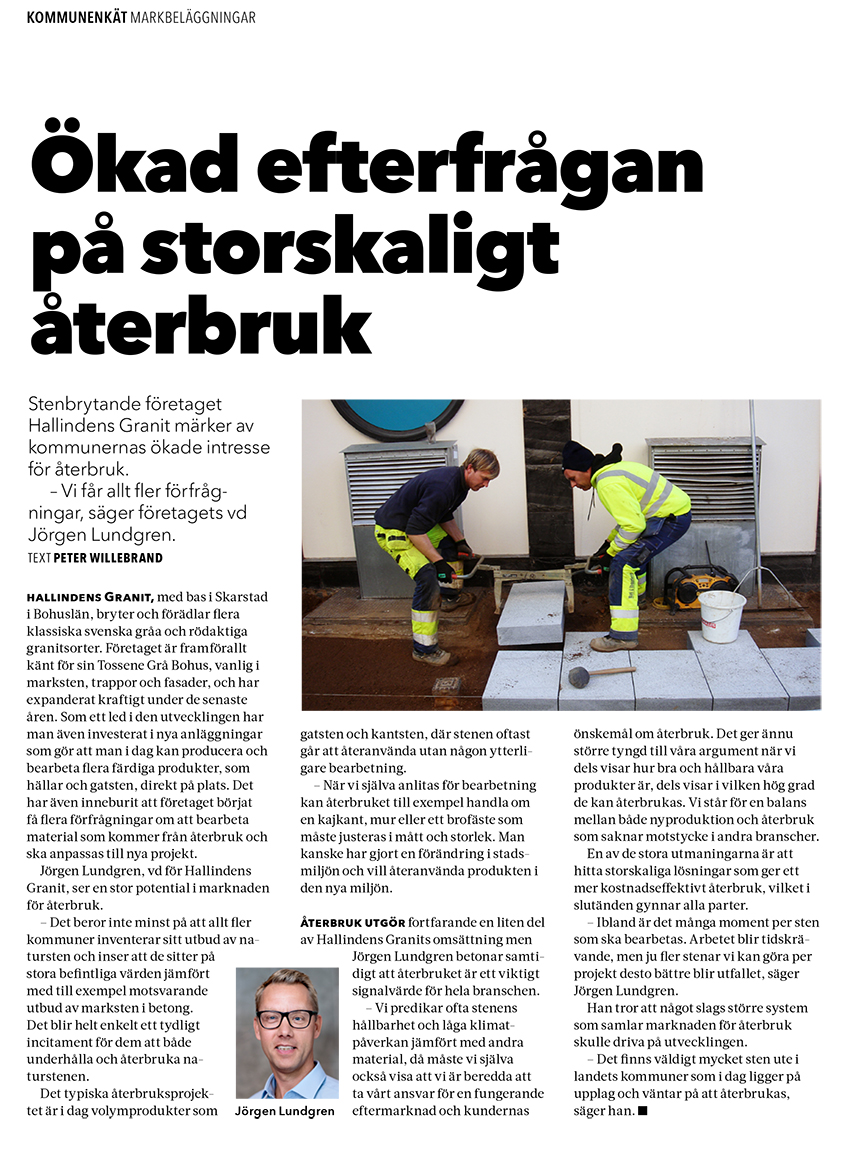
The stone quarrying company Hallindens Granit has noticed growing interest from municipalities in the reuse of natural stone. – We are receiving more and more inquiries, says the company’s CEO, Jörgen Lundgren.
Hallindens Granit, based in Skarstad in Bohuslän, extracts and processes several classic Swedish grey and reddish granite varieties. The company is best known for its TOSSENE Grey Bohus granite, commonly used in paving stones, stairways, and façades, and has expanded significantly in recent years. As part of this growth, the company has invested in new facilities that now enable it to manufacture and process several finished products, such as slabs and cobblestones, directly on site. This development has also led to an increasing number of requests to process reclaimed stone materials that are to be adapted for new projects.
Jörgen Lundgren, CEO of Hallindens Granit, sees great potential in the market for reuse. – This is largely because more and more municipalities are inventorying their natural stone assets and realizing that they possess substantial existing value compared with, for example, a similar stock of concrete paving products. This creates a clear incentive for them to both maintain and reuse their natural stone.
Today, the typical reuse project involves volume products such as cobblestones and curbstones, where the stone can often be reused without any additional processing. – When we are hired to process reclaimed material, it may involve a quay edge, a retaining wall, or a bridge abutment that needs to be adjusted in terms of dimensions and size. Perhaps changes have been made to the urban environment, and the client wants to reuse the product in its new setting. Reuse still represents only a small share of Hallindens Granit’s revenue, but Jörgen Lundgren emphasizes that it carries important symbolic value for the entire industry. – We often promote stone’s durability and low climate impact compared with other materials. If we do that, we must also demonstrate that we are prepared to take responsibility for a functioning aftermarket and for our customers’ desire to reuse materials. This gives even greater weight to our arguments when we can show both how durable our products are and to what extent they can be reused. We represent a balance between new production and reuse that is unmatched in other industries.
One of the major challenges is finding large-scale solutions that make reuse more cost-effective, ultimately benefiting all parties involved. – Sometimes there are many processing steps required for each individual stone. The work becomes time-consuming, but the more stones we can process within a project, the better the outcome, says Jörgen Lundgren. He believes that some form of larger system bringing together the reuse market would help accelerate development. – There is a tremendous amount of stone stored in municipal stockpiles across the country today, waiting to be reused, he says.